51% of Total U.S. Spirits Exports Went to EU in 2025 As Exports to Canada Fell 70%: DISCUS
At first glance, it may be surprising that the EU is the largest export market for U.S. spirits. After all, for the last year, at least, we've heard a steady cacpohony of alarm about the impact on bev/al exports of President Trump's trade war with Canada.
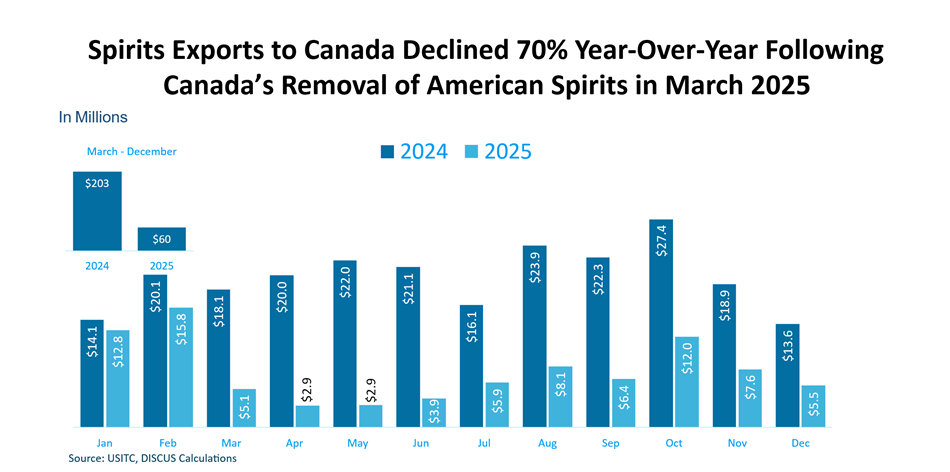
And, indeed, U.S. spirits exports to Canada are down 70% year-over-year since Canada removed American spirits from retail shevles in March 2025 through 2025, the Distilled Spirits Council of the U.S. reported. Canada fell from the second-largest U.S. spirits export market in 2024 to sixth-largest in 2025.
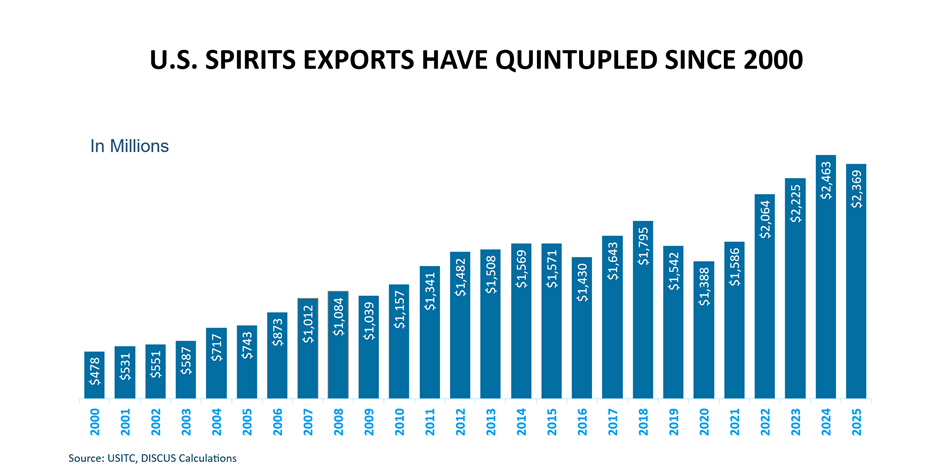
That caused total U.S. spirits exports to decline nearly 4% in 2025 to $2.37 billion, following record-high export levels in 2024. But despite the recent decline, U.S. spirits exports have grown fivefold over the past 25 years, from $478 million in 2000 to $2.37 billion in 2025.
n Canada, exports of U.S. spirits fell 70% year over year from the start of provincial sales bans in March 2025 through December 2025. Canada fell from the second-largest U.S. spirits export market in 2024 to sixth-largest in 2025.
The detail was contained in a report to the U.S. Trade Representation. DISCUS urged leaders on both sides of the border to reach a resolution that restores U.S. spirits to retail shelves throughout Canada and returns the U.S. and Canadian spirits sectors to permanent zero-for-zero tariffs and full market access.
The EU remained the largest destination for U.S. spirits exports in 2025, receiving $1.2 billion in U.S. spirits exports and accounting for 51% of total exports. In August 2026, the EU indefinitely suspended a 30% retaliatory tariff on U.S. distilled spirits that had been scheduled to take effect Aug. 6. DISCUS urged the administration to ensure retaliatory tariffs on American spirits are not reimposed.
The submission also points to opportunities in markets where American spirits continue to face significant tariff and non-tariff barriers. In India, the tariff on bottled Bourbon was reduced from 150% to 100%, and exports of bottled Bourbon to India increased nearly 85% in 2025 compared with 2024. Year to date in 2026, bottled Bourbon exports to India increased nearly 160% compared with the same period in 2025. DISCUS is urging the administration to secure tariff reductions across all categories of bottled and bulk U.S. spirits that are at least comparable to those India has provided to EU and UK spirits. Currently, spirits from the UK into India are facing a 75% tariff, and EU spirits will benefit from this preferential rate in early 2027. Over the next decade, India’s tariffs on EU and UK spirits will be reduced to 40%.
The DISCUS submission also identifies a wide range of additional tariff and non-tariff barriers affecting U.S. spirits exporters, including discriminatory tax treatment, labeling, standards and other technical barriers in markets around the world.
The submission applauds the administration for securing tariff reductions for American spirits through agreements with Argentina, Cambodia, Malaysia, Indonesia, Taiwan and Ecuador. U.S. spirits exports to those countries totaled $27.5 million in 2025, accounting for approximately 1% of total U.S. spirits exports. DISCUS urged the administration to swiftly implement the agreements already secured and pursue additional agreements with priority markets, including India, Brazil, Vietnam and Thailand.
“The U.S. distilled spirits industry is a major contributor to American manufacturing, agriculture, exports and employment, but distilleries need new access to international markets to compete and grow,” added Maron. “Securing fair and reciprocal market access and removing unnecessary trade barriers will help American distillers increase exports, support jobs and create greater opportunities throughout the spirits supply chain.”
The U.S. distilled spirits industry generates more than $250 billion in annual economic activity and supports approximately 1.7 million jobs across production, distribution, hospitality and retail. The industry sourced more than 2.73 billion pounds of grain from American farmers in 2024, an increase of 134% over the last decade.
“Our industry has demonstrated what American manufacturers can accomplish when they have fair and reciprocal access to global markets,” said Robert Maron, DISCUS senior vp-international trade policy and market access. “For U.S. spirits producers, increasing exports and opening new markets, not tariffs on imports, represent the most viable path to returning to growth and global competitiveness. "We urge the administration to swiftly implement the trade agreements already negotiated, pursue new market access opportunities and secure the permanent return to tariff-free trade with our key trading partners.”
The U.S. spirits sector currently has zero-for-zero tariffs with 51 countries. In 2025, 81% of U.S. spirits exports went to countries that impose zero tariffs, while approximately 98% of U.S. spirits imports originated from these countries.
The submission highlights the continued impact of trade disputes and market access barriers in two of the industry’s most important export markets, Canada and the European Union.
In Canada, exports of U.S. spirits fell 70% year over year from the start of provincial sales bans in March 2025 through December 2025. Canada fell from the second-largest U.S. spirits export market in 2024 to sixth-largest in 2025. DISCUS urged leaders on both sides of the border to reach a resolution that restores U.S. spirits to retail shelves throughout Canada and returns the U.S. and Canadian spirits sectors to permanent zero-for-zero tariffs and full market access.
Comments ()