Spillovers on Tap: How AVAs Benefit Local Brewery Growth
By Matthew McMahon, PhD; Sarah Quintanar, PhD; Gary Wagner, PhD; Guest Editor: Angelo A. Camillo, PhD
American Viticultural Areas (AVAs) are federally designated geographical regions intended to help consumers more easily differentiate wine-producing regions in the United States. Though there are differences between the specifics of AVA designations and those of appellations in other countries, the main premise is largely the same: signaling a standard of quality.
Dating back to Duke Philip the Bold’s 1395 edict banning both the growth of certain grape varieties and the watering down of wines produced in the Duchy of Burgundy, which were prestigious enough to be the favorite of the Pope and his court, winemakers and policymakers alike have used legal certifications as a means to indicate a wine’s quality (e.g., Phillips, 2023).
Today, in the US, for a wine bottle to feature an AVA name on its label, at least 85% of grapes used to make it must have been grown in that AVA and the wine must be fully finished within a state where the AVA is located.[1] This helps more easily share information of consistent quality – a consumer who is considering purchasing a bottle made by a winery with which they are unfamiliar can still have some notion of the wine’s tannin, sweetness, acidity, body, and overall quality.

With creation of the first AVA in 1980, the wine industry immediately saw value in being located within an AVA, as evidenced by the rapid growth of the AVA designation program: there were 56 AVAs by the end of 1983, and there are now 279 AVAs spanning 34 of the 50 US states (TTB, 2026).
Academic research largely corroborates this: wines within an AVA sell for higher prices than otherwise-identical wines without an AVA name, all else equal (Cross et al., 2011). Importantly, research also provides evidence that this price increase is specifically due to the AVA name causing a boost to the wine’s reputation, thereby shifting its demand curve to the right (Cross et al., 2011).
With AVA designation playing such a critical role in forming, maintaining, and guaranteeing the reputation of wines from a geographic region, it is natural to then consider whether this reputation extends to other products – and if so, to which ones and to what degree?
Given the close relationship between wine and beer, a natural starting point is to consider whether these AVA-driven reputational benefits include spillovers to breweries as well. Although breweries cannot use the official AVA designation on their products, breweries may loosely associate themselves with an AVA in some way.
For example, a brewery may name itself or its beers using wording that resembles an AVA’s name, or consumers may have enough knowledge about both an AVA and a brewery to know that the brewery is located in the AVA – whether local consumers who know the geography well or tourists who drive past a brewery en route to a winery or hotel.
Prior to the modern explosion of interregional and global trade, the vast majority of people consumed mostly products that were created near them – they drank what could be made with crops that could be grown locally, according creating long-standing cultural preferences (Unwin, 1991; Anderson & Pinilla, 2021), which created the traditional “Hop-Vine Divide” (Turner, 2020; McGuire, 2013; Rehm et al., 2003).
Consistent with this dichotomy, modern empirical research supports the idea that people tend to view wine and beer as substitutes in consumption, especially for craft beer and for on-premises consumption (e.g., Čiderová & Ščasný, 2022; Meng et al., 2014; Sousa, 2014). As applied to our work, beer and wine being substitutes in consumption would imply that AVA creation negatively impacts the local brewery industry.
However, context is particularly important. For example, when split by consumption location, Čiderová & Ščasný (2022) find that an increase in the price of beer for on-premises consumption leads to an increase in off-premises sales of both beer and wine. As applied to our work, beer and wine being complements in consumption would imply that AVA creation positively impacts the local brewery industry.
We empirically estimate whether creation of an AVA positively or negatively impacts the brewery industry in and very near the given AVA. This is, in effect, establishing a new context in which complementarity/substitutability between wine and beer can be measured: consumer responses to wine policy.
Data
We coalesce data from many sources to create a dataset that features 22 years of observations for all 62,499 census tracts either in a state with an AVA (excluding Hawaii) or a state which a direct land border to one with an AVA (as of December 31, 2021). This yields 1,374,978 total observations.
Existing research finds that the age of AVAs, the size of AVAs, and sub-AVA designations drive impacts within the wine industry (Cross et al., 2011; Keating, 2020).[2] We thus consider these variables in our models, too.
First, for each tract in each year (tract-year), we calculate the age of the oldest AVA in that tract. Second, we calculate a count of all AVAs (by level) in the tract in that year. Last, we construct three measures of the percentage of each census tract overlayed by AVAs. The “sum” metric takes the sum of that tract-AVA overlay percentage and sums them for all AVAs in the given tract; this measure can be greater than 100%. We also create the “max possible” metric, which is the same as the sum metric but with a maximum value of 100%. Last, the “min possible” metric measures the minimum possible percent of the tract that could be covered by AVAs given the AVAs that exist, and their overlay percentages, in the tract; it equals the size of the largest tract-AVA overlay percentage in that tract.
Notably, while there is no formal, legal concept of a sub-AVA – i.e., all AVAs are identical in the eyes of the law – the concept is ubiquitously known across the wine industry, related industries, and even many consumers. We broaden this understanding to encompass AVA “levels” in our econometric model: a “level-1 AVA” is not contained within any other AVA, a “level-2 AVA” is contained only within a level-1 AVA, etc.
While much research has shown that sub-AVA designation positively impacts reputation, demand, and prices beyond those from the top-level AVA designation (Rendleman et al., 2016; Keating, 2020; Gokcekus & Finnegan, 2017; Matthews & Medellin-Azuara, 2017), some researchers have also found a more nuanced, crowding-out effect at higher levels of AVA saturation (Delmond and McCluskey, 2025; Livat et al., 2019). We acknowledge the established importance of differential impact by AVA level and thus split our independent variables of interest by AVA level when possible.[3]
These spillovers can flow via many different channels. Founded in 1882, Korbel Champagne Cellars, lies within the Russian River Valley AVA, a level-3 AVA, as well as three higher-level AVAs (Bartell, 2024). Inspired by one of their winemakers who also homebrewed, Korbel opened Russian River Brewing Co. in nearby Santa Rosa in 1997 (James, 2026). Purchased by its brewmaster in 2003, it has become one of the most awarded and critically acclaimed breweries in the world, especially known for its beer titled Pliny the Elder (Eisenberg, 2014).
Owing to their location and origin, the company maintains close ties to the wine world, aging certain beers in specific wine barrels, re-fermenting beers with fresh local wine grapes, and even launching a seasonal beer titled “It Takes A Lot of Great Beer To Make Great Wine,” which they market as a toast to Sonoma County grape pickers and winemakers (Russian River Brewing, 2026; Vallery, 2016; Wharton, 2020; Beer Advocate, 2011).
Other examples abound, too. The former Marketing Manager at Firestone Walker Brewing Company, which is the second-largest raft brewery in California and is based in Central California’s Templeton Gap AVA (and the two AVAs that contain it), is now the Executive Director of the region’s Paso Robles Wine Country Alliance (Birrificio del Ducato, 2022; Wine Business, 2019).
Other factors may also impact the local brewery industry besides our main explanatory variables of interest. These variables are included in our analysis so we can disentangle these effects from the AVA effects. Specifically, we include median home prices, median household income, population, population density, and racial composition at the tract-year-level, as well as county-year-level net job creation rate.[4] Lastly, we also include state-year-level Alcohol Freedom Index, which measures legal restrictions on alcohol sales.
We study how the previous variables impact the brewery industry. We measure the relative strength of the brewery industry in an area compared to the strength of the area’s overall economy. We do so using both brewery firm count relative to overall firm count and brewery employment count relative to overall employment. We use a standard mathematical transformation so that the measured effects are in terms of percent changes (Bellemare & Wichman, 2019). This yields two measures of the intensity of the brewery sector in the local economy: “brewery establishment intensity” and “brewery employment intensity.”[5]
Methodology
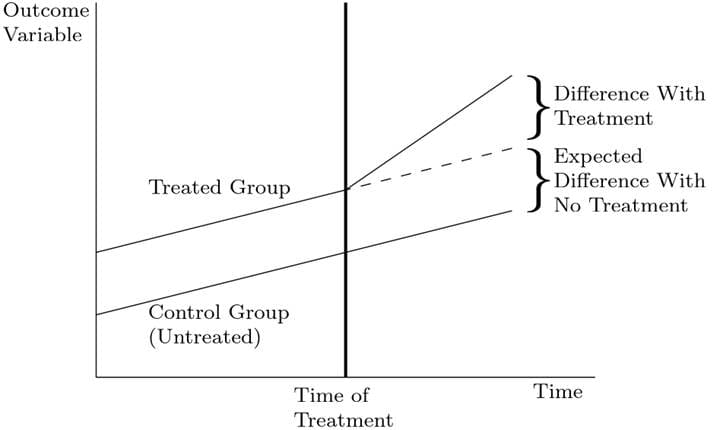
Our yearly census tract-level data allow us to detect the impact of AVA formation on beer using a regression technique known as “difference-in-differences” (DID) estimation. Intuitively, consider two locations that are nearly identical in every way – for example, similar climates, populations, median household incomes, state alcohol laws, and numbers of breweries. Because all of these factors, which impact brewery formation/closure/employment, are the same in both locations, we would expect the number of breweries to grow over time at roughly the same pace in each tract. Now suppose that, ten years down the road, an AVA is formed in one of these locations – but not in the other.
We look at how the evolution of the brewery industry changes over time (the “first difference”), and we compare how those two locations’ evolutions differ from one another (the “second difference”) in the period following the AVA formation.
In essence, the brewery industry should grow in parallel in these two locations, and so any deviation from parallel trends in the post-AVA-creation years must be due to the formation of the AVA. See Figure 1 below for a graphical representation of the difference-in-differences concept.
Figure 1. Visual Representation of Difference-in-Difference Regression Concept
Of course, finding nearly identical locations is tough. To fix this, we include variables representing all other factors that could impact brewery establishment and employment counts as additional explanatory variables within our DID regression estimation. Our rich geographic dataset of 22 years for all census tracts across the 35 states in the contiguous US that have or share a land border with an AVA by the end of 2021 allows us to perform exactly this analysis.
Result 1: Age Matters
The results of this analysis are striking. First, AVA age matters. For each additional year that the oldest AVA in the tract existed, brewery establishment intensity and employment intensity increase by an additional 0.25% and an additional 0.16%, respectively. Thus, while the initial effect may be small in the first year after the tract’s first AVA is created, this then compounds over time, with a constant rate of growth implying overall exponential growth moving forward. Intuitively, as the AVA builds its reputation over time, local breweries increasingly benefit from this reputational growth, too. Like a fine wine, these spillover effects get better with age.
Result 2: Uniqueness & Strength in Numbers
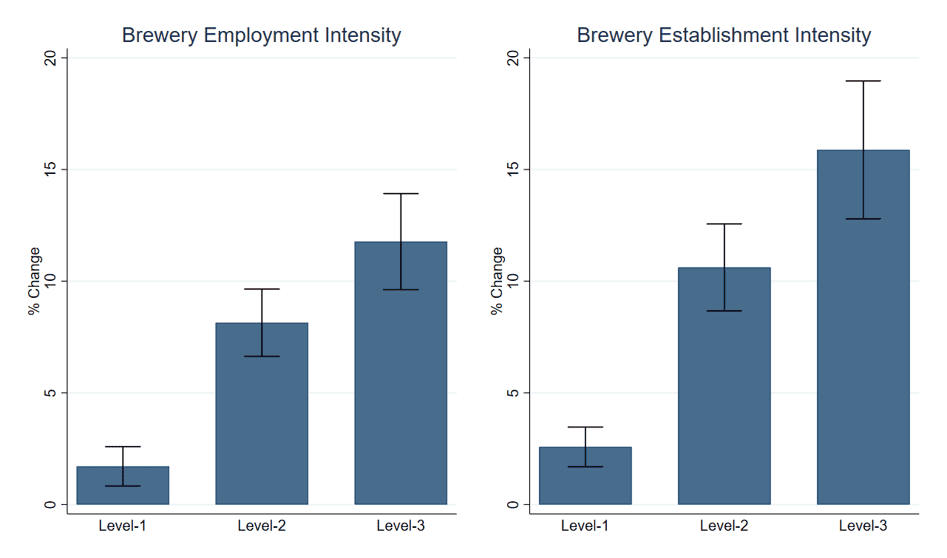
In addition to age, AVA intensity also matters: the creation of a new AVA in an area has a profound positive impact on the local brewery industry. As Figure 2 illustrates, adding a new top-level AVA to a census tract (which may or may not expand the percent of that tract that is covered by top-level AVAs), holding age of the oldest local AVA (and all else) constant, causes the local brewery establishment and employment intensities to increase by 2.58% and 1.71%, respectively. This is a sizeable effect, and it stacks for each additional top-level AVA in the tract.
Figure 2. Effect of Adding One Additional AVA, by Type
Intuitively, an area with multiple different AVAs is potentially more unique. For example, Oregon’s Willamette Valley sub-designations differentiated themselves and generated a new level of distinctiveness (Gokcekus and Finnegan, 2017). As a result, their regional reputation premiums significantly increased (Gokcekus and Finnegan, 2017). Since reputation is driven by standing out from others, if the uniqueness of these multiple-AVA locales further boosts reputation, demand would increase correspondingly. This intuition aligns with our results, demonstrating a spillover to the beer industry.
Considering our AVA intensity measures as a proxy for uniqueness is again a useful interpretation as we now turn to sub-AVAs. Sub-AVAs, by their very nature, are geographically smaller and more niche than their top-level AVA counterparts. Thus, one would expect sub-AVAs to have a larger impact than top-level AVAs (Rendleman et al., 2016; Keating, 2020; Gokcekus & Finnegan, 2017). Indeed, for both measures of brewery industry intensity, as Figure 2 illustrates, increasing the number of level-2 AVAs has quadruple the positive impact that increasing the number of top-level AVAs has. While not an official designation, consumers are clearly aware of the “sub-AVA” distinction and build that into their reputation calculations.
It appears that there are diminishing marginal returns to the level of sub-AVA, at least in terms of the impact on a region’s beer reputation. One additional level-3 AVA increases both measures of brewery industry intensity by roughly 1.5 times that caused by one additional level-2 AVA.
Result 3: Saturation & Location Matter
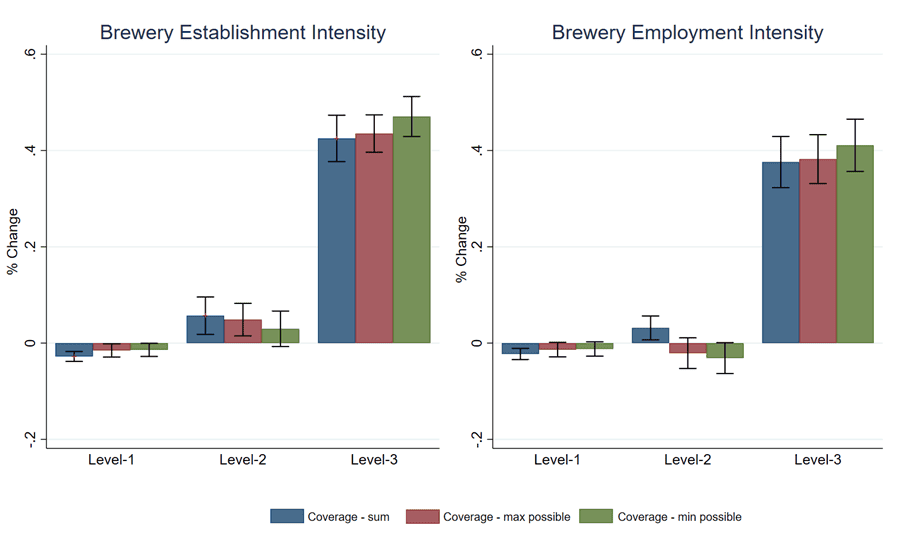
Last, we consider AVA intensity as measured by our three metrics for the percentage of a census tract’s area that is inside an AVA, which all illustrate a similar effect. We find no evidence that increasing the percent of the census tract that contains an AVA – when the number of AVAs in the tract does not change – has any effect on the local brewery industry intensity for either level-1 or level-2 AVAs. However, for level-3 AVAs, we find that if an AVA that already exists in a tract expands to cover an additional ten percent of that tract’s area, the local brewery industry intensity increases by 4%. Thus, for breweries, operating very close to or within the AVA boundary matters most for the most unique AVAs – the level-3 AVAs – while proximity matters less for “less-unique” AVAs.
Figure 3. Effect of Increasing AVA Coverage, by Type and Coverage Measure
Conclusion
Despite the widespread perception that the wine and beer industries are closely related, there has been little consideration about how AVA policy impacts local beer industries. We find that breweries strongly benefit from AVA designation even though it has no structural implications to the brewing process and offers them no clear ability to signal quality. To our knowledge, this is the first technical consideration of AVAs’ impacts on an industry other than wine.
We find that benefits to the brewery industry age like wine, continually improving over time. Uniqueness is also paramount. Whether driven by a larger number of (any level of) AVAs or increasingly niche sub-AVAs, locales that are more unique see a greater impact on the local brewery industry. Local coverage by AVAs only matters for sub-AVAs that are nested within other sub-AVAs, again capturing the value of uniqueness. This result is consistent with breweries choosing to locate very close to or within these level-3 sub-AVA boundaries, whereas close proximity matters less for less-unique AVAs.
To the wine industry, this provides a valuable alliance. Because they benefit from local AVAs, brewers are incentivized to invest their resources into helping with the creation of local AVAs. There are other benefits to the local wine industry, too. This spillover creates a unique opportunity for co-marketing with local breweries, hotels, and other tourism-related sectors, for example. Future work should look to see which other local industries also benefit, such as the hotel or distillery industries, to also bring them into the fold.
It also speaks more broadly to the notion that AVAs provide a cross-industry region-wide economic boon. Our results provide data-driven evidence to help local political leaders understand these positive spillovers across the local economy, a critical step in securing government support and resources needed for potential AVA designations. In doing so, a key takeaway from our results is that both private firms and government agencies should retain a focus on creating, maintaining, and advertising their region’s uniqueness, whether through a high density of local AVAs or through niche sub-AVAs (or both), as the region’s reputation continues to grow over time.
References
Anderson, Kym and Vincente Pinilla. (July 2, 2021). “Wine’s belated globalization, 1845-2025.” Applied Economic Perspectives and Policy. 44(2), 742-765. doi: https://doi.org/10.1002/aepp.13174
Bartell, John. (August 16, 2024). “How California’s oldest sparkling wine maker was saved by a jailbreaking granny | Bartell’s Backroads,” ABC10. Accessed: https://www.abc10.com/article/news/local/how-californias-oldest-sparkling-wine-maker-was-saved-by-a-jailbreaking-granny/103-7b4b8bd3-f74d-4431-bd56-b3bab7d1e075
Beer Advocate. (August 27, 2011). “It Takes A Lot Of Great Beer To Make Great Wine,” Beer Advocate. Accessed: https://www.beeradvocate.com/beer/profile/863/72512/
Bellemare, Marc F. and Casey J. Wichman. (July 10, 2019). “Elasticities and the Inverse Hyperbolic Sine Transformation,” Oxford Bulletin of Economics and Statistics 82(1), pp.50-61. doi: https://doi.org/10.1111/obes.12325
Birrificio del Ducato. (June 8, 2022). “California Star: The New Session IPA in Collaboration with Firestone Walker,” Birrificio del Ducato. Accessed: https://www.birrificiodelducato.it/en/california-star-the-new-session-ipa-in-collaboration-with-firestone-walker/
CATO. “Alcohol Freedom,” Freedom in the 50 States. Accessed: June 10, 2026 at https://www.freedominthe50states.org/alcohol
Čiderová, T., & Ščasný, M. (November 14, 2022). “Estimation of Alcohol Demand Elasticity: Consumption of Wine, Beer, and Spirits at Home and Away from Home.” Journal of Wine Economics, 17(4), 329-337. doi: https://doi.org/10.1017/jwe.2022.42
Cross, R., Plantinga, A. J., & Stavins, R. N. (May 2011). “What is the Value of Terroir?” American Economic Review, 101(3), 152-156.
Delmond, Anthony R. and Jill J. McCluskey. (September 15, 2025). “Impacts of Regional Designations on Prices,” Journal of Wine Economics, 20(3), 268-285. doi: https://doi.org/10.1017/jwe.2025.10079
Eisenberg, David. (July 7, 2014). “How Pliny the Elder Became the Best Beer in America,” Brewbound. Accessed: https://www.brewbound.com/news/how-pliny-the-elder-became-the-best-beer-in-america/
Gokcekus, O., & Finnegan, C. M. (2017). “Price Effects of Establishing a New Sub-AVA within Oregon’s Willamette Valley AVA.” Journal of Wine Economics, 12(4), 345-353.
James, Scott. (February 28, 2026). “The Evolution of Russian River Brewing History Unveiled,” Sonoma County Navigator. Accessed: https://www.sonomacountynavigator.com/made-local/russian-river-brewing-history/
Keating, G. B. (August 2020). “An Empirical Analysis of the Effect of Sub-Divisions of American Viticultural Areas on Wine Prices: A Hedonic Study of Napa Valley.” Journal of Wine Economics, 15(3), 312-329. doi: https://doi.org/10.1017/jwe.2020.29
Livat, Florine; Julian M. Alston; and Jean-Marie Cardebat. 2019. “Do denominations of origin provide useful quality signals? The case of Bordeaux wines.” Economic Modelling, 81, 518-532. ⟨10.1016/j.econmod.2018.06.003⟩. ⟨hal-03389556⟩
Matthews, W. A., & Medellin-Azuara, J. (2017). “The Economic Impacts of the San Luis Obispo County and Paso Robles AVA Wine Industry: A Report Prepared for the Paso Robles Wine Country Alliance and the San Luis Obispo Wine Country Association.” Accessed: https://cail.ucdavis.edu/publications/PASO%20WINE2.pdf
McGuire, Avery. (November 12, 2013). “Move Over Wine,” Nordic Food Lab Accessed: https://nordicfoodlab.org/blog/2013/11/move-over-wine/
Meng, Y., Brennan, A., Purshouse, R., Hill-McManus, D., Angus, C., Holmes, J., & Meier, P. S. (2014). “Estimation of Own and Cross Price Elasticities of Alcohol Demand in the UK – A Pseudo-Panel Approach Using the Living Costs and Food Survey 2001-2009.” Journal of Health Economics, 34, 96-103.
Phillips, Rod. (September 21, 2023). “By decree: The Duke of Burgundy’s 14th century AOC,” The World of Fine Wine: News & Features. Accessed: https://worldoffinewine.com/news-features/by-decree-duke-burgundy-14th-century-aoc
Rendleman, C. M., Hoemmen, G. A., Altman, I., Taylor, B., Moon, W., & Smith, S. (2016). “Wine Industry Competitiveness: A Survey of the Shawnee Hills American Viticultural Area.” Wine Economics and Policy, 5, 4-13.
Rehm, J.; Nina Rehn; Robin Room; Maristela Monteiro; Gerhard Gmel; David Jernigan; and Ulrich Frick. (September 17, 2003). “The Global Distribution of Average Volume of Alcohol Consumption and Patterns of Drinking.” European Addiction Research, 9(4), 147-156. https://doi.org/10.1159/000072221
Russian River Brewing. (Accessed August 18, 2026). “Intinction – Pinot Noir,” Russian River Brewing. Accessed: https://www.russianriverbrewing.com/brew/intinction-pinot-noir/
Sousa, J. (2014). “Estimation of Price Elasticities of Demand for Alcohol in the United Kingdom.” Knowledge, Analysis, and Intelligence – HM Revenue & Customs Working Paper 16. Accessed: https://assets.publishing.service.gov.uk/media/5a7db32b40f0b65d88633e1c/HMRC_WorkingPaper_16_Alcohol_elasticities_final.pdf
TTB – Alcohol and Tobacco Tax and Trade Bureau. (March 24, 2026). “List of AVAs by Establishment Date,” Wine Industry. Accessed: https://www.ttb.gov/regulated-commodities/beverage-alcohol/wine/ava-establishment-dates
Turner, Victoria. (2020). “Alcohol consumption in the WHO European Region.” World Health Organization Regional Office for Europe, Cultural Contexts at a Glance, 1, 1-6.
Unwin, Tim. (1991). “Wine and the Vine: An Historical Geography of Viticulture and the Wine Trade.” Routledge, Taylor & Francis Group, London and New York.
Vallery, Jess Poshepny. (October 2016). “It Takes a Lot of Great Beer to Make Sonoma County Wine,” Sonoma Magazine. Accessed: https://www.sonomamag.com/it-takes-a-lot-of-local-beer-to-make-sonoma-county-wine/
Wharton, GT. (January 2, 2020). “Reviewed: Russian River Intinction – Sauvignon Blanc,” The Full Pint. Accessed: https://thefullpint.com/beer-reviews/reviewed-russian-river-intinction-sauvignon-blanc/
Wine Business. (January 22, 2019). “Paso Robles Wine Country Alliance Announces New Executive Director,” Wine Business. Accessed: https://www.winebusiness.com/news/people/article/208686
____________________________________
Matthew McMahon, PhD, is a tenured Associate Professor of Economics at West Chester University. He holds a PhD and MA in Economics from the University of Tennessee, as well as a BA in Economics and a BS in Mathematics from Appalachian State University. With more than 15 years of teaching experience, he has taught courses in micro and macroeconomics, environmental economics, resource economics, and labor economics. His research has been published in a variety of academic economics journals, such as Management Science, Environmental & Resource Economics, and the Journal of Behavioral & Experimental Economics.
Contact: mmcmahon@wcupa.edu
Sarah Quintanar, PhD, is Interim Chair & Clinical Associate Professor, Department of Data Analytics & Statistics University of North Texas. She earned her master’s degree and Ph.D. in Economics from Louisiana State University. She is currently serving her second year as interim chair for the Department of Data Analytics and Statistics at the University of North Texas. She also currently serves on the Board of Directors of the Association for University Business and Economic Research (AUBER). With more than 20 years of teaching experience, she has taught courses in economics, business analytics, and data analytics. Her research focuses on applied microeconomics, including wine economics, sports economics, and discrimination in legal and economic settings, with an emphasis on using data to answer challenging questions.
Contact: sarah.quintanar@unt.edu
Gary A. Wagner, PhD, is Acadiana Business Economist/ BORSF Eminent Scholar Endowed Chair at the University of Louisiana at Lafayette. He holds a Ph.D. in Economics from West Virginia University. Dr. Wagner’s research interests range from regional economics to state and Local public finance, with a particular focus on economic development. His work has appeared in many leading economics journals including the Journal of Urban Economics, Journal of Law and Economics, Journal of Economic Behavior and Organization, National Tax Journal, Economics and Politics, Regional Science and Urban Economics, and Research Policy. He serves as Editor-in Chief of Public Finance Review and previously served as Co-Editor of Contemporary Economic Policy (2020–2026).
Contact: gary.wagner@louisiana.edu
Angelo Camillo, PhD, is Associate Professor of Management and Wine Business at Sonoma State University and former F. Korbel and Bros., Professor of Wine Business at the Wine Business Institute. He holds a degree from the Heidelberg Hotel Management School (Germany), an MBA from San Francisco State University, and a PhD from Oklahoma State University, as well as certifications in Management Development from Cornell University and Harvard University. He has published six books and over one hundred research articles and book chapters and is the Editor – in – Chief of the Wine Business Journal. He has been a visiting professor at Institutions in South Korea, Italy, and China (Guangzhou SCNU and Guanghua School of Management at Peking University), and guest lecturer at the Wine Business Program at Brock University Ontario, Canada.
Contact: camillo@sonoma.edu
[1] This is a simplified description – for precise details on labeling requirements see TTB’s “Wine Labeling: Appellation of Origin” details at https://www.ttb.gov/regulated-commodities/beverage-alcohol/wine/labeling-wine/wine-labeling-appellation-of-origin.
[2] Variables are generated from the TTB and AVA Digitization Project data sources.
Comments ()