The Woman Who Changed How Vintners View Yield and Quality
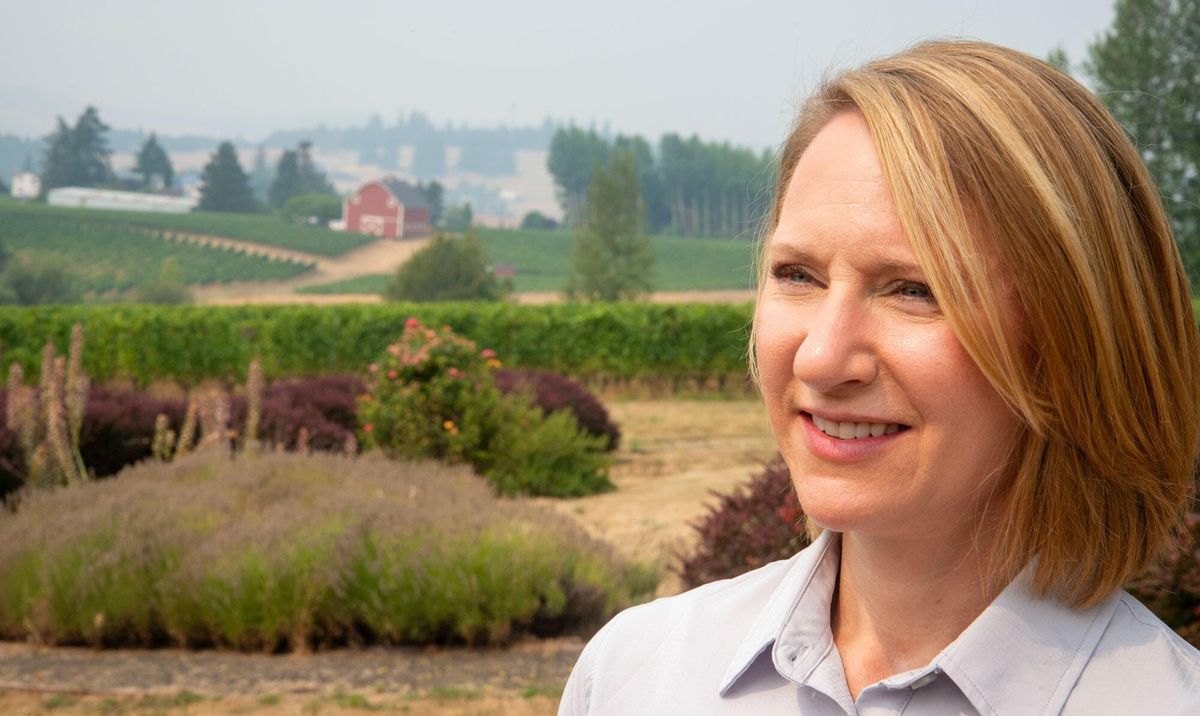
For years, many Oregon Pinot noir producers believed that making high-quality wine required cutting fruit from the vine and keeping yields low.
The practice reflected concern about balance, ripeness and Oregon’s reputation for premium wine. But Oregon State University Extension Service viticulture specialist Patty Skinkis kept seeing vineyard crews cut off fruit in late July and early August, even when vines were not carrying unusually heavy crop loads.
Skinkis brought together growers, vineyard managers and winemakers to test the question in commercial vineyards and wineries.
“Low yield equals high quality,” Skinkis said. “Putting it that simple, it became this paradigm that was pervasive, and in Oregon it was almost the benchmark of quality.”
The decade-long OSU study tested whether cluster thinning — removing grape clusters before harvest — consistently improved Pinot noir fruit and wine quality. Participants conducted trials in their own vineyards, processed the trial fruit into wines and reported data to OSU researchers.
The project included 25 wine companies. Fifteen participated for at least three years. The analysis included 18 vineyard sites across seven Willamette Valley American Viticultural Areas, federally recognized wine grape-growing regions.
A paper on the project by Kiley Osterman and Skinkis, “Long-term citizen science project led to Pinot noir yield management changes,” won the American Society for Enology and Viticulture’s 2026 Best Viticulture Paper Award. The award recognized research that challenged a widely held assumption in premium grape growing and offered practical insights for vineyard management.
The findings matter for an industry central to Oregon agriculture, tourism and rural economies. The Oregon wine and wine grape industries generated an estimated $8.49 billion economic impact in 2024, according to the Oregon Wine Board. Pinot noir remains Oregon’s leading wine grape variety.
For growers and winemakers, the research offered a more flexible way to think about yield. Rather than applying one target across years and sites, participants learned to weigh crop level against season, vine balance, fruit chemistry, wine goals and production costs.
Skinkis said the award allowed her to explain the full arc of the project in June at the 2026 ASEV National Conference in Boise, Idaho — from the early skepticism to the industry changes that followed.
“It was very well received,” she said. “The audience got the bigger picture; they got the whole story.”
From skepticism to study
Skinkis is a professor in the OSU Department of Horticulture in the College of Agricultural Sciences and a core faculty member of the Oregon Wine Research Institute. Her work focuses on production questions that affect wine grape quality, sustainability and profitability.
Ken Wright, founder of Ken Wright Cellars in Carlton, said Skinkis had earned industry trust by focusing on questions that mattered to producers.
“We’ve really been happy with Patty in her role,” Wright said. “She really is a fantastic listener and she’s absolutely on top of those things that are most critical for us to understand.”
Before the decade-long study began, Skinkis conducted three-year studies in two commercial Pinot noir vineyards in Oregon. When she presented early results to industry audiences, many growers and winemakers were interested but unconvinced.
“They were skeptical,” Skinkis said. “They thought, ‘How could this be? That something we held so strongly could have no impact?’”
Skinkis realized that more traditional studies would not be enough.
“I could do 20 more of these studies for the rest of my career, and nobody would be convinced,” she said.
So, she changed the model. Instead of asking commercial vineyards to set aside space for OSU researchers to manage, Skinkis asked growers and winemakers to become active research partners. They followed protocols, collected data, thinned to different crop levels, harvested samples and evaluated what happened in their own vineyards and wineries.
OSU provided training and protocols. Growers implemented two or more cluster-thinning treatments in a randomized design, with at least three replicates. Producers collected field and winery data and reported it to Skinkis, who analyzed the data and shared results each year through participant meetings and reports.
The project was not a demonstration trial. Skinkis wanted replicated research that could produce publishable data. But she also wanted participants to learn directly from the process.
“I saved a lot of money because I didn’t need to prove to them; they proved it to themselves,” she said.
A project built on trust
The project required more than protocols. It required trust, patience and steady communication.
Skinkis recruited participants, trained them, provided procedures and stayed in contact through the growing season. Participants counted shoots and clusters, thinned vines to designated crop levels, collected harvest data and met annually to review coded results.
Companies could see their own data alongside results from other vineyards without identifying individual sites. The annual reports showed little impact of cluster thinning on fruit ripeness at harvest, no differences in vine growth and no wine sensory differences based on cluster thinning.
The approach was unusual in viticulture. Skinkis said some academic colleagues questioned whether the project would produce conventional research outputs quickly enough.
“Some of my colleagues told me it was academic suicide,” she said.
But Skinkis believed the question was too important to answer only in university-managed plots. Yield affects quality, labor, grower-winemaker relationships and the bottom line.
At the midpoint of the study, nearly half of participants were beginning to change how they thought about crop level and fruit quality. By the end, all companies that fully participated had made yield changes, and those that reported yield changes increased target yields by an average of 39%.
The project also addressed a tension that can exist between growers and winemakers. A grower may spend the season producing healthy fruit only to be asked to cut off a portion of it. Skinkis said the research gave growers better information to guide those conversations.
“It was very clear they learned that they could look at yield more objectively rather than subjectively,” she said.
That shift mattered. Instead of thinning to a fixed number or a visual ideal, participants began to consider what the vines, the site and the season could support. The paper concluded that the work emphasized managing for vine balance specific to the vineyard site, rather than to a universal yield standard.
Lessons from the vineyard
At Ken Wright Cellars, the research confirmed questions he and some others in the industry had already begun asking about crop levels in warm years.
Wright said Skinkis understood that the question was not only academic. It affected whether wineries could maintain quality while staying financially viable.
“Patty understood how germane this was to us, just to remain in business,” Wright said. “It was a big deal.”
Wright said Pinot noir producers have to respond to the season in front of them rather than follow a fixed recipe. In warmer years, he said, leaving more crop can slow ripening and help preserve the time needed to develop more complex aromas and flavors.
“Rather than ‘recipeing’ how you approach crop level … in the warmest years you need to carry more crop in order to extend season,” Wright said.
For Wright, the issue is both sensory and financial. Cutting too much fruit can shorten the season, increase farming costs per ton and produce wines that lack balance, he said.
“In those years you leave more crops, you can achieve balance,” Wright said. “And guess what? You get to make a little more wine. You might actually make money.”
Mark Gould, vineyard manager for Ken Wright Cellars, said the old conventional wisdom in the Willamette Valley was that Pinot noir yields needed to stay near 2 to 2.5 tons per acre to achieve quality. Warm vintages complicated that thinking.
“It really did not serve us to lighten the load that much,” Gould said. “We learned pretty quickly that it’s better off to hold more grapes in order to rein in the plant and slow the progression of ripening.”
The participatory work required significant effort from vineyard teams. Seth Miller, a vineyard manager at Ken Wright Cellars, said crews counted shoots multiple times during the season, counted clusters, collected samples from reference vines before harvest and kept fruit separate for analysis.
“We were counting shoots three times a season … and then counting clusters on those shoots, and through harvest,” Miller said.
The work changed how the team managed some vineyards. Miller said trial wines from 2014 showed that unthinned vines produced wines that were more balanced. In 2015, a warm year, the team chose to thin much less across one vineyard and harvested one of its largest crops.
“It paid off,” Miller said. “It was good. It was profitable.”
Why it worked
Skinkis is still working through the scale of the data generated by the project. The vineyard and fruit data cover 10 years and 25 companies, making it difficult to compress into a single peer-reviewed paper. She said the most useful information often exists at the individual vineyard scale, where each site, season and management approach can be understood in context.
The award-winning paper focused on the people who took part, what they learned, how information moved through the industry and whether participating changed behavior.
The paper found that participants changed thinning practices, increased target yields and reported improved profits. All participants reported improved profits with yield changes, and 62% cited reduced thinning costs.
The paper also found that participants shared what they learned within their companies and with other industry colleagues. Contract growers used project data and information in contract negotiations, fruit pricing and client selection.
That spread of information was part of the project’s legacy. Participants met annually, reviewed results, compared observations and used the information in their own decision-making. Skinkis said some participants finished the project by asking what research question they could tackle next.
“It was more than just work,” she said. “It was part of a community.”
Skinkis said the goal was never simply to tell growers to leave more fruit on the vine. It was to help them make better decisions.
“The goal here is to change — well, to learn, but also help facilitate change in a very simple way that would dramatically change their economics,” she said. – Chris Branam, news and public affairs manager, Oregon State University
Comments ()